Note
How to value and sell a small online business
How to prepare a small site or store for sale, what Flippa's free valuation does and does not promise, and what the listing and success fees cost.
Verdict. Flippa's free valuation is an indicative range, and the listing fee is charged whether or not the business sells.
| Option | What to know |
|---|---|
| Self-service | Packages start at US$29 for a 60-day listing, for an asking price up to $100,000. The success fee is 10% if it sells. The listing fee is charged either way. |
| Brokers | Optional. Packages start at $899 plus a 10% success fee, for businesses from $100,000 up. The upfront fee is charged even if it does not sell. |
A small online business is saleable when a stranger can see how the money arrives, what it costs to keep arriving, and what breaks if you leave. A marketplace does not create that. It gives the stranger a place to look, and it charges you for the listing and, if they buy, for the introduction.
The figures in this note are from Flippa’s sell page, including its own FAQ, read on 18 November 2026. They are not a quote. Other pages on this site are under notes and versus. The tool comparisons for a site you might later sell are Wegic vs Wix vs Squarespace and Printify vs Printful.
Get the records before you get the number
Flippa’s own selling checklist starts in the right place. Gather revenue, profit, traffic, customer information, and operating costs. Buyers want to know how the business makes money, what it costs to make that money, and whether the pattern holds. A content site is judged on traffic sources and how replaceable the writing is. A store is judged on margin, suppliers, and what it costs to acquire a customer. A subscription product is judged on retention. Put the metrics that match the model in the listing. A single revenue screenshot is not a set of books.
Write down what you do each week that a buyer would have to do. If the answer is “everything,” the price should reflect a job, not a machine. That discount is larger than most first-time sellers expect, and no calculator removes it.
Use a valuation as a range, then stress it
Flippa’s free valuation asks for business information and compares it with sales on Flippa. The sell page says the tool looks at model, category, age, and buyer interest, that it draws on a large set of past sales, and that it takes a few minutes. The same FAQ says the result is indicative. It is not the price a buyer must pay.
Run it, then change the inputs you are least sure about. If profit only looks acceptable because you are not paying yourself, put a wage in and run it again. If most of the traffic is one social account you would not include in the sale, take that traffic out. The second number is the one to talk about. Flippa also says you can compare the business with similar businesses that sold recently. Do that with the filters visible, not from a single comparable that flatters you.
Decide whether you are listing it or hiring it out
Self-service on Flippa, according to the sell-page FAQ, is for an asking price up to $100,000. Packages start at US$29 for a 60-day listing with basic visibility. Higher packages add reach, a longer window, priority support, and confidentiality agreements. The success fee for self-service is 10% of the final transaction value. The listing fee is charged whether or not you sell. The success fee is charged when you do.
Flippa’s in-house brokers are optional. The sell page says they hold a Certified Mergers and Acquisitions Advisors accreditation and that the service covers businesses from $100,000 to $50 million and up. The FAQ says broker packages start at $899 plus a 10% success fee, with the exact amounts depending on the package, and that the upfront fee is payable even if the business does not sell. Brokers, as described there, add buyer qualification, negotiation, and help finishing the transaction. You can also sell publicly or to a private list.
Hire the broker path if you will not run the questions yourself, or if the number is large enough that a missed disclosure is expensive. Stay on self-service if the books are clean, the asking price is under the self-service cap, and you can answer a buyer the same day. The Flippa marketplace is the front door either way. The sell page describes listing, matching, negotiation with LOI and asset-purchase templates, then payment and transfer, including escrow.
What to refuse during the sale
Do not hand over the only admin login before the escrow terms are clear. Do not promise a supplier relationship you cannot assign. Do not hide a traffic source that violates a platform’s rules. Those are the issues that collapse a small deal after everyone has spent the fee. Flippa’s page talks about NDAs for a reason. Use one before you send profit-and-loss detail to a stranger, and keep customer data out of the first email.
Also separate the sale of the business from the tools it uses. A store on a print platform, or a site on a builder, transfers only if that vendor allows the account to move and you have exported what the buyer needs. Read that vendor’s transfer rules yourself. This note did not test an account transfer.
What the free valuation tool returned for an example business
On 19 November 2026, from 6:38 to 6:44 a.m. Eastern, we ran Flippa’s free valuation on a hypothetical business. It is not a site we own, and it was not listed. The inputs were a 2-year-old review and affiliate content site, 40,000 monthly users, 85% organic, USD 18,000 of revenue over 12 months, and USD 3,600 of expenses, which is USD 14,400 of profit. There was no category for a plain affiliate site, so the form was set to Content, then Review Site. It asks for 12-month revenue and expenses, not a profit field.
flippa.com/valuation-tool returned a 404. The working tool was a chatbot, about 17 questions, about 3.5 minutes, then about 20 seconds of calculation.
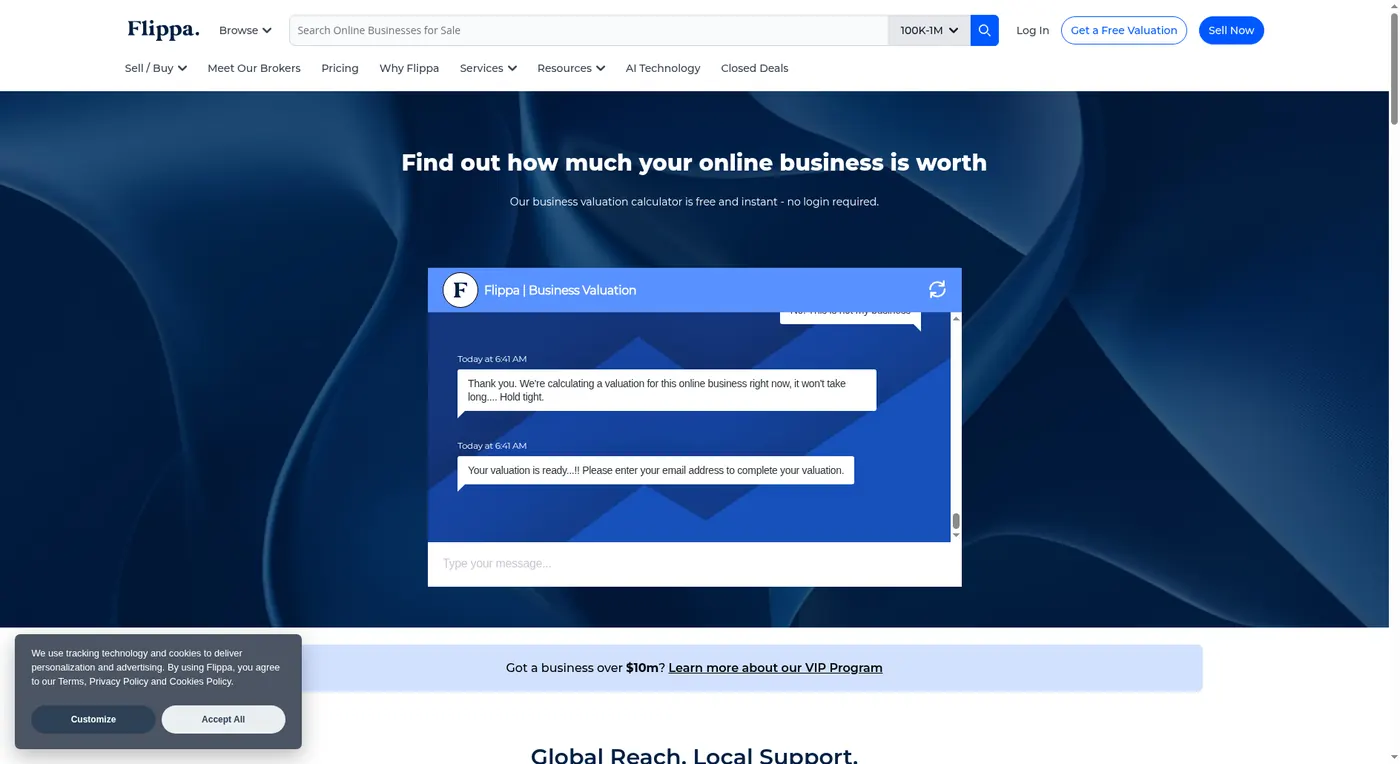
After the questions, the result was gated on an email address. The next step asked for a mobile number. Typing “skip” got past it. Off-market interest was declined. Weekly updates were declined. The greeting on the result used a placeholder name, which is blurred below. The example was labeled example-affiliate-site.com.
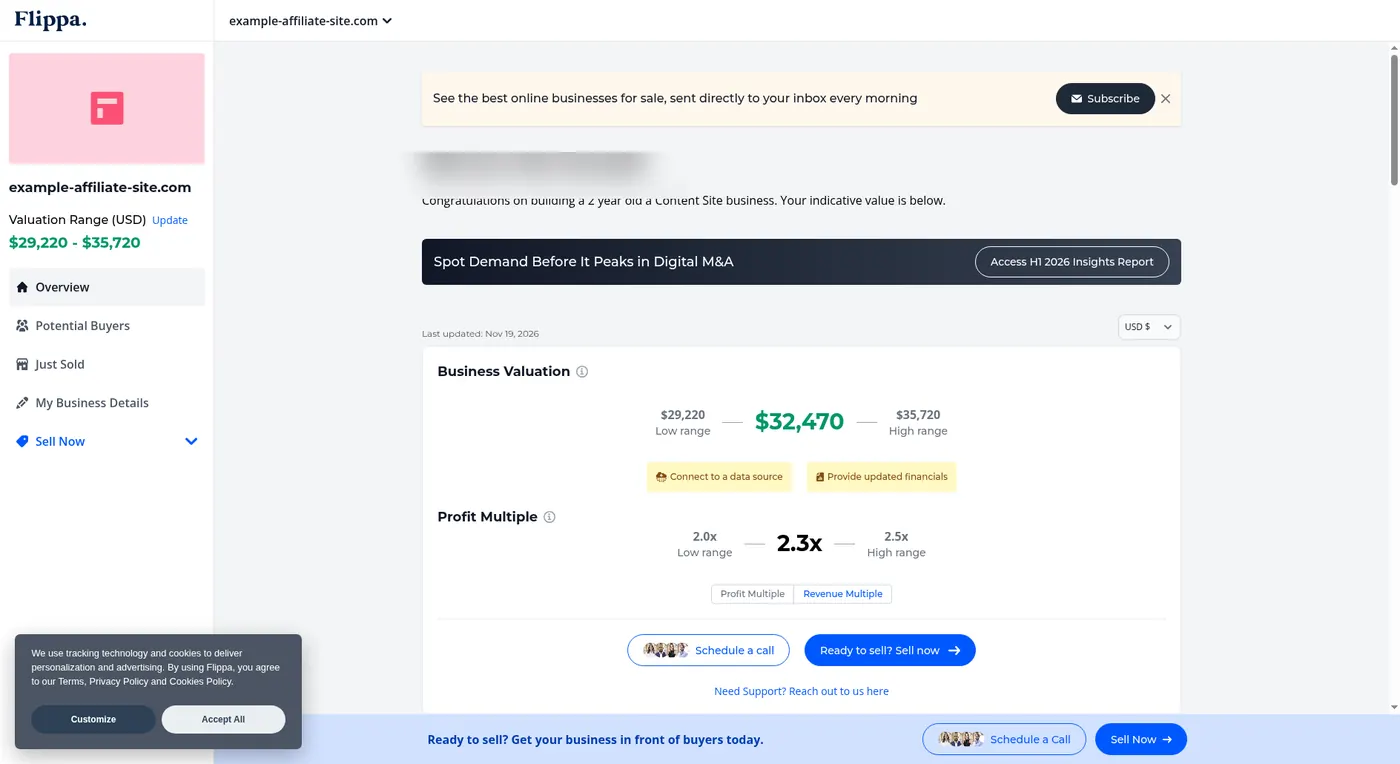
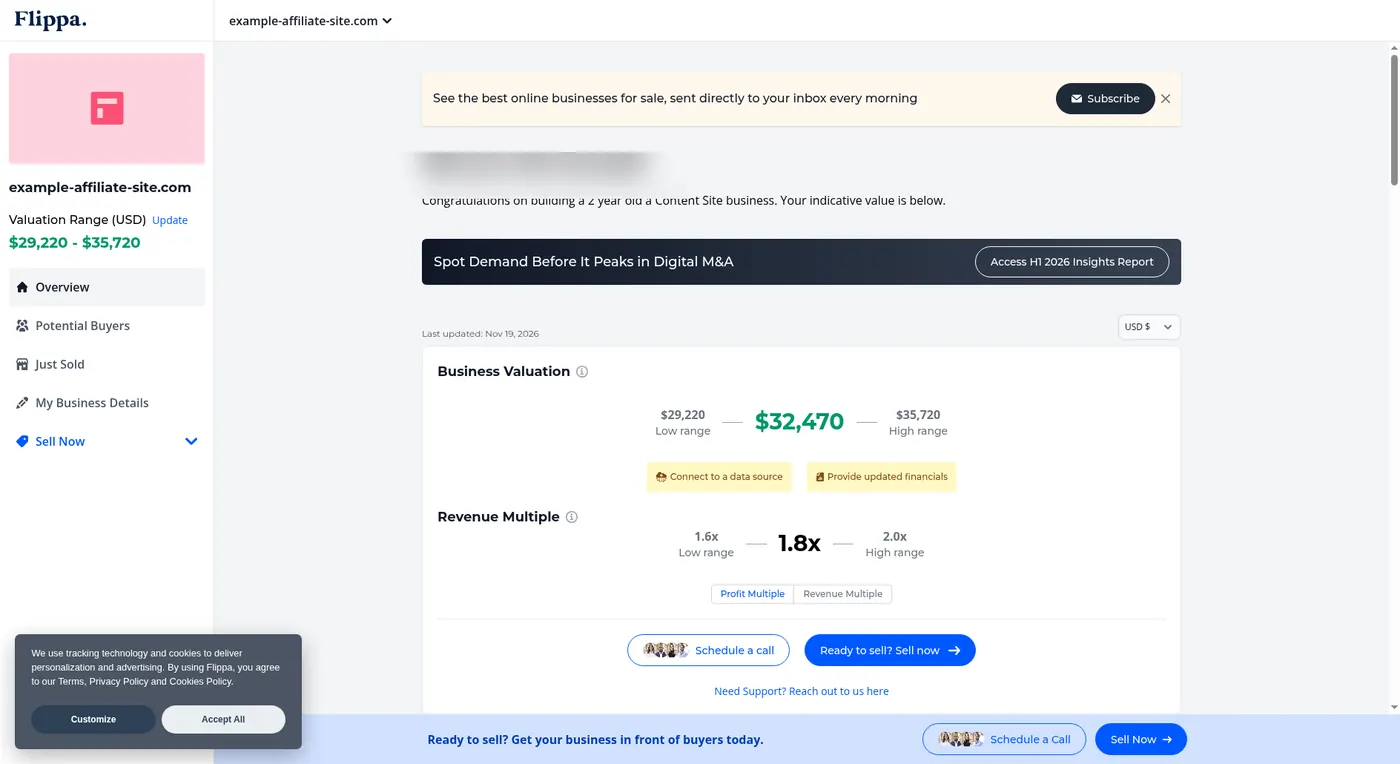
There was no written explanation beyond a comparison with businesses sold on Flippa. The result page offered a call, Sell now, connecting a data source, buyer matches worded as “3,127 potential buyers” and “1,062 buyer mandates,” and Just Sold comparables, including one at USD 32,500 shown at 2.1x profit and 1.3x revenue. Those buyer counts and that comparable are Flippa’s labels on the result, not a count we made.
Our valuation estimator does not call Flippa. It multiplies profit and a multiple you type. It will not reproduce USD 32,470 unless you type the inputs that produce that arithmetic yourself.
What this note did not do
No business was listed, and no listing fee was paid. The valuation above is the example session, not a sale. Flippa’s totals will differ by package, and the FAQ says to read the current self-service fee page for the full menu. The percentages above are the ones printed in the sell-page FAQ on the day it was read. Check them again before you pay a listing fee you cannot get back.
Is a free online valuation the price I will get?
No. Flippa says its calculator is an indicative valuation, not a guaranteed sale price. It combines what you enter with historical sales and buyer interest. Buyers still discount messy books, owner dependence, and a single traffic source.
What does Flippa charge if the business sells?
Flippa's sell-page FAQ says self-service packages start at US$29 for a 60-day listing, for businesses with an asking price up to $100,000, and that the success fee on those sales is 10% of the final transaction value. You pay the success fee only if it sells.
Do I pay the listing fee if nobody buys?
Yes. Flippa says the listing fee and the broker's upfront fee are payable whether or not the business sells. The success fee is the part that waits for a completed sale.
When is a broker worth calling?
Flippa says broker support can be worth the cost on a higher-value or more complicated sale. Its broker page, as quoted in that FAQ, starts at $899 plus a 10% success fee. The exact package depends on the business. Self-service stops being the default once you cannot explain the numbers yourself.